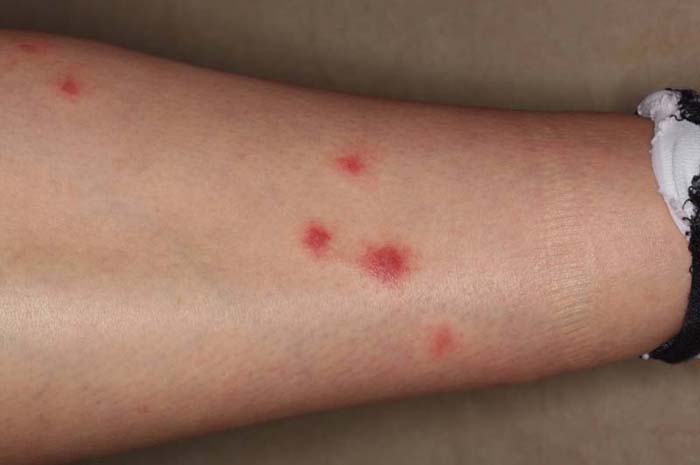
Cutaneous reactions to arthropod bites (CRAB) are inflammatory and/or allergic reactions, characterized by an intensely pruritic eruption at the bite sites hours to days after the bite, manifested by solitary or grouped urticarial papules, papulovesicles, and/or bullae that persist for days to weeks; patients are often unaware of having been bitten. In some cases, systemic symptoms may occur, ranging from mild to severe, with death occurring from anaphylactic shock. Arthropod bites are also the method of transmission of many systemic infections and infestations.
Causes of Cutaneous Reactions to Arthropod Bites
- Mites Produce pruritus and/or allergic reactions through salivary proteins deposited during feeding. Harvest mites (chiggers) may present as intense pruritus on the ankles, legs, belt line; mites usually fall off after feeding or may be scratched off. In nonsensitized individuals, 1 to 2 mm pruritic papules are seen. In sensitized individuals, CRAB may be papular urticaria, vesiculation, or granulomatous reaction with fever and lymphadenopathy.
- Ticks Reactions include foreign body reactions, reactions to salivary secretions, reactions to injected toxins, and hypersensitivity reactions. Tick paralysis is caused by a toxin secreted in the saliva of the tick.
- Spiders Brown recluse spider (Loxosceles reclusa) bite causes reactions ranging from mild urticaria to full-thickness necrosis (loxoscelism). “Widow” spiders (Latrodectus) inject a venom that contains a neurotoxin. (αlatrotoxin) producing reactions at the bite site as well as varying degrees of systemic toxicity.
- Scorpion Venom also contains a neurotoxin that can cause severe local and systemic reactions.
- Blister Beetles Contain the chemical cantharidin, which produces blister when the beetle is crushed on the skin.
- Black Flies Bites produce local reactions as well as black fly fever, characterized by fever, headache, nausea, generalized lymphadenitis.
- Nonbiting Flies Flies commonly feed on open wounds, exudates, and skin ulcers and may deposit eggs at these sites, resulting in wound myiasis. Fly larvae can burrow into injured or normal skin, invading through the epidermis into the dermis, resulting in furuncular myiasis. In some cases, larvae move about the subcutis (migratory myiasis), mimicking the pattern of cutaneous larva migrans.
- Bedbugs Nocturnal feedings produce a linear arrangement of papular urticaria.
- Hymenoptera Bees, hornets, wasp bites can produce painful stings, and anaphylaxis in the sensitized individual.
- Caterpillars and Moths Hairs can produce local irritant and allergic reactions.
- Fleas (Cat, Dog, Bird) Bites tend to cause more local reactions than human flea bites.
- Chigoe or Sand Fleas(Tunga penetrans) Recently impregnated female flea penetrates skin of a human host, burrows into epidermis to dermal-epidermal junction, where she feeds on blood drawn from host vessels in superficial dermis. Enlargement of the buried flea to 5 to 8 mm causes local pain in the infested skin. Mature eggs (150 to 200) are extruded singly from a terminal abdominal orifice during a period of 7 to 10 days. The female dies shortly after egg extrusion, and the infested tissues collapse around it; ulcerations can occur at the site. Inflammation and secondary infection can arise if parts of the flea are retained in the tissue.
Symptoms of Cutaneous Reactions to Arthropod Bites
- Allergic reactions
- Skin rash
- Itch
Diagnosis
Clinical diagnosis, at times confirmed by lesional biopsy.
Treatment
Larvae in Skin Tungiasis: remove flea with needle, scalpel, or curette, attempting to remove all flea parts; oral thiabendazole, (25 mg/kg/d) or albendazole (400 mg/d for 3 days), effective for heavy infestations. Furuncular myiasis: suffocate larvae by covering the larvae with vaseline; remove the following day when dead.
Glucocorticoids Potent topical glucocorticoids given for a short time are helpful for intensely pruritic lesions. In some cases, a short tapered course of oral glucocorticoids can be given for extensive CRAB that are persistent.
Antimicrobial Agents Secondary Infection Antibiotic treatment with topical agents such as mupirocin ointment or antistaphylococcal/ antistreptococcal agents if secondary infection is present.
Systemic Infection/Infestation Treat with appropriate antimicrobial agent.
Prevention
Avoid contact with arthropods. Apply insect repellent such as diethyltoluamide(DEET) to skin. Apply permethrin spray (permanone [USA]) to clothing. Use passive measures such as screens, nets, clothing. Treat flea-infested cats and dogs; spray household with insecticides (e.g., malathion, 1 to 4% dust) with special attention to baseboards, rugs, floors, upholstered furniture, bed frames, mattresses, and cellar.
References
- https://accessmedicine.mhmedical.com/content.aspx?bookid=1700§ionid=113788812&jumpsectionID=113788990
- https://www.aafp.org/afp/2013/1215/p841.html
- https://www.dermatologyadvisor.com/dermatology/arthropod-bite-reaction-bug-bite-insect-bite-insect-sting/article/691623/
- https://www.ncbi.nlm.nih.gov/pubmed/18564283